Zorka Lednárová - Where freedom ends
A customer service center in city hall, a movie theater, or a bank: places we take for granted as part of urban life and which are easily accessible to able-bodied citizens. For people with limited mobility, however, they often present an obstacle—sometimes an insurmountable one.
In her work, Zorka Lednárová has long focused on the theme of barriers in the city—both the visible ones and those that most people are not even aware of. She herself uses a wheelchair and thus knows this issue from daily experience. Although current architectural and urban planning principles claim to accommodate the needs of all residents, the reality of accessability is often much more complex.
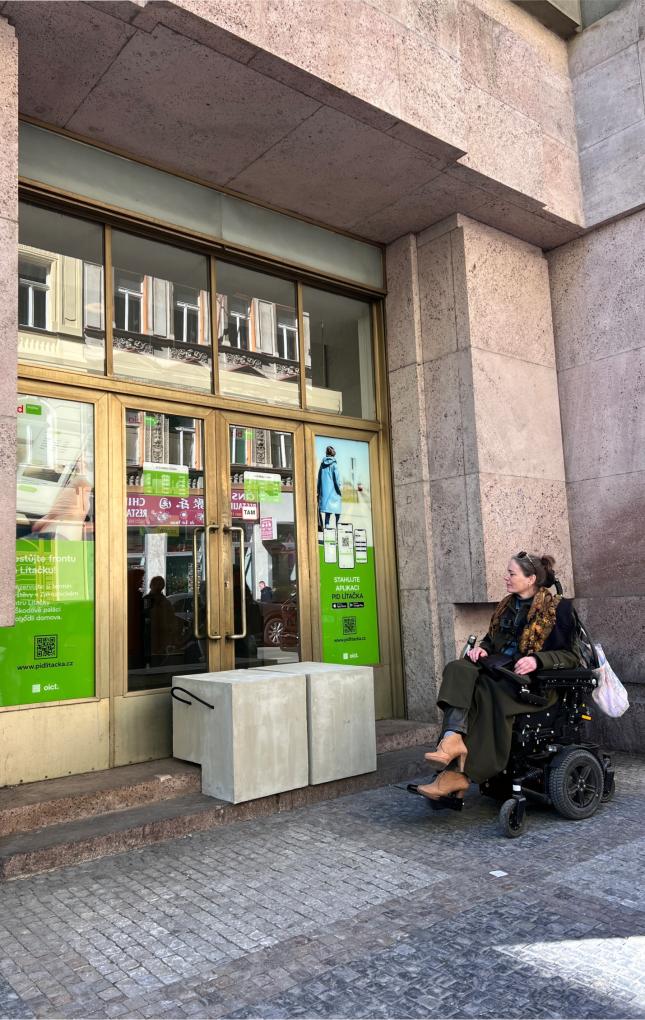
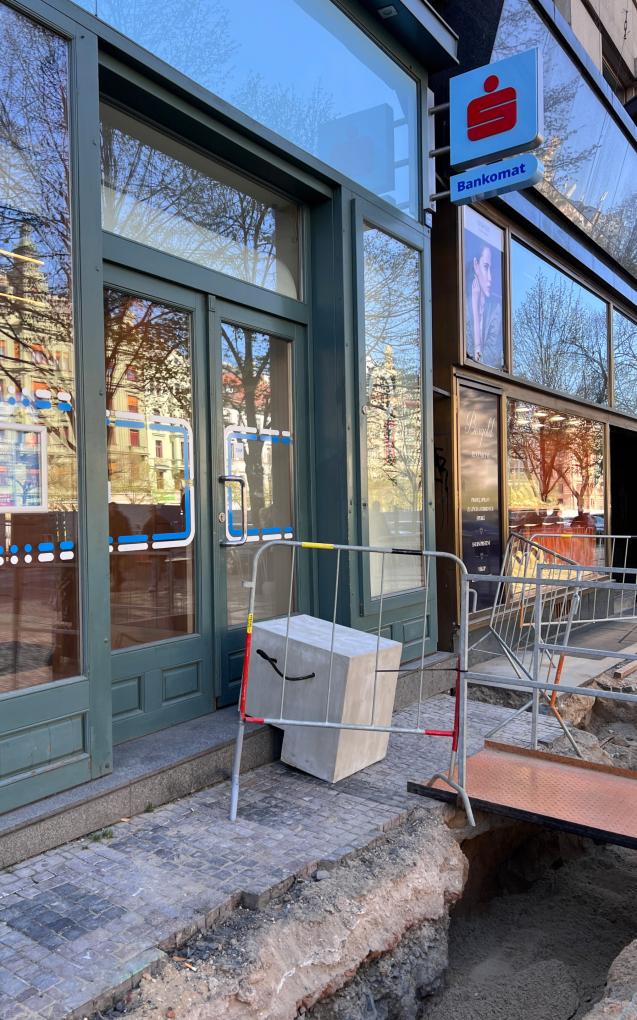
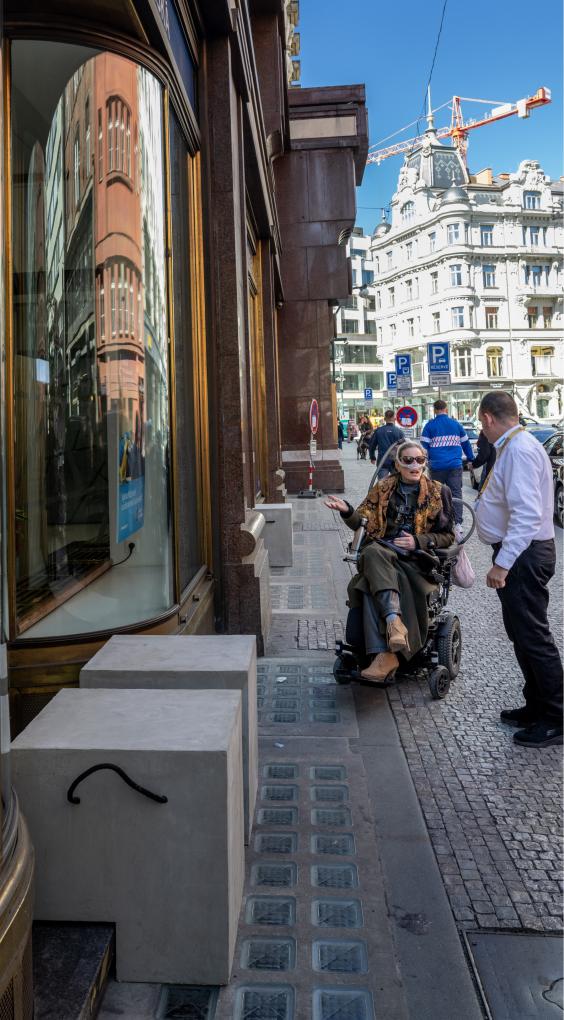
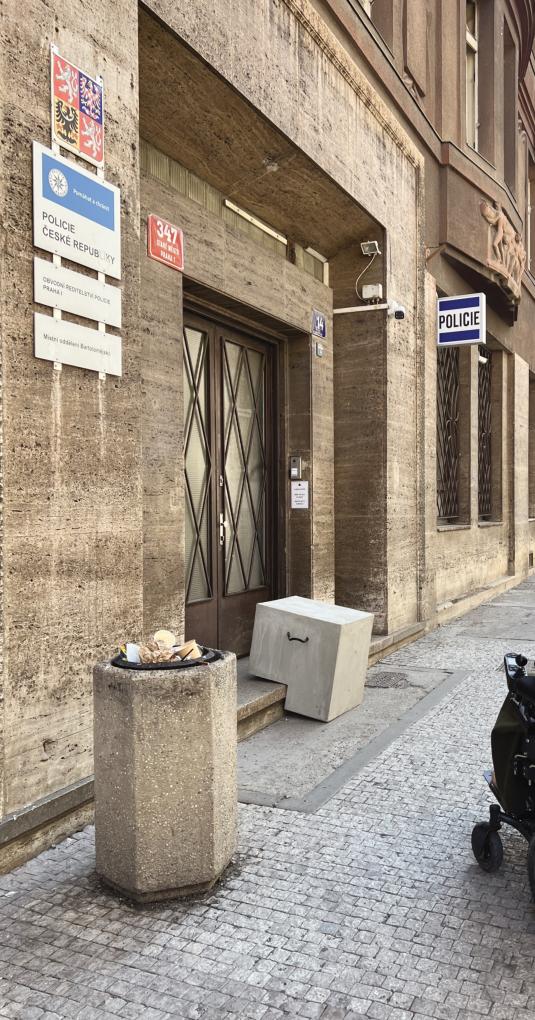
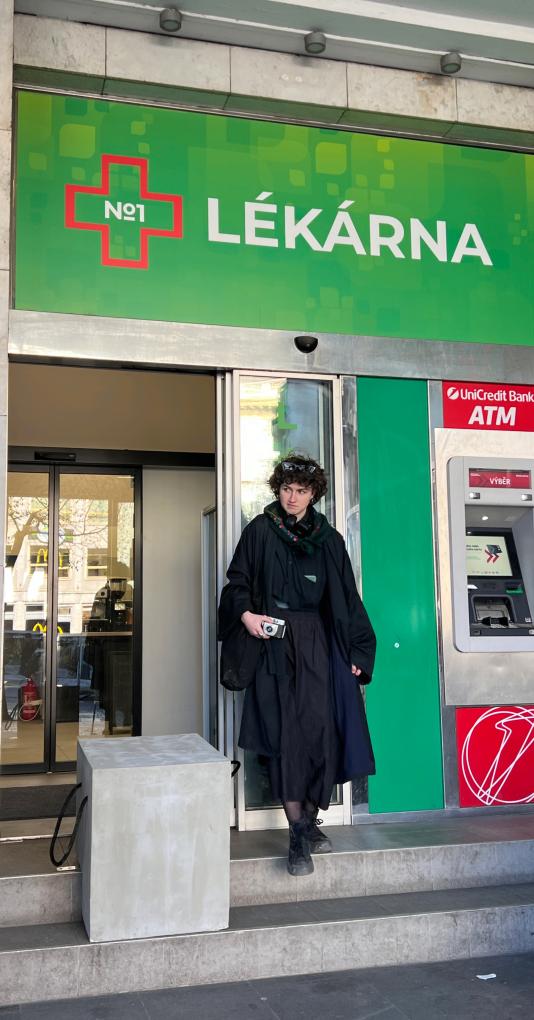
In the exhibition Where Freedom Ends at the Artwall gallery, the artist draws attention to places where a person in a wheelchair is excluded by just one or two steps. Accompanied by local students, she places wooden models of enlarged stairs in public spaces thus creating symbolic barriers that highlight the problem that is commonly overlooked. Documentation of these site-specific actions confronts society with the existence of barriers that, while inconspicuous, are impassable for many people. The aim of the project is not merely to point out that our cities still do not meet the needs of all their residents. Lednárová invites us to envision a public space in which inclusion would not be an exception, but the norm.
The exhibition was organized in collaboration with the Artivist Lab gallery, where a parallel exhibition of the same name is on view until June 14th, featuring additional works by the artist and documentation of the project.
About the artist: Zorka Lednárová is a Slovak artist living in Germany. She studied sculpture in Bratislava, Kiel, and Hangzhou, China. She subsequently completed postgraduate studies at the Universität der Künste in Berlin in curatorial studies, art in public spaces, and cultural policy. From 2007, she ran the exhibition space Okk/Raum 29 (Organ kritischer Kunst) in Berlin for eight years. Her work has been presented in various European countries as well as outside Europe, and she has long focused on themes of borders, freedom of movement, bodily experience, and social barriers.
Curators: Zuzana Štefková, Lenka Kukurová
BLACK HOLE: A Performative Action Painting by Zorka Lednárová
We invite you to a performance by Zorka Lednárová: Black Holes, which will take place on August 30, 2026, from 2 - 3 p.m. in the the Center for Contemporary Art, Dukelských hrdinů 25a. The performance is part of the exhibition project Where Freedom Ends
Black Hole is a large-scale performative painting that connects the physical metaphor of cosmic phenomena with the current state of society. The artist draws on the principles of a black hole—an object that inexorably absorbs everything that crosses its event horizon. This point of no return becomes the central symbol of the work: an invisible boundary beyond which lies loss, annihilation, the impossibility of return, and the collapse of established rules. Singularity—as a state in which ordinary equations cease to apply—is transformed, in a figurative sense, into an image of social structures that have reached a critical point.
The work reflects changes in society—a shift in values, radicalization, growing lobbying, polarization, and destructive interventions in the cultural environment. Culture, as a sensitive barometer of social shifts, emerges here as the first indicator of an impending collapse. The black hole becomes a metaphor for a system that absorbs energy, time, and the pursuit of equality and freedom, and offers no response in return. It is a space where voices, initiatives, and even entire groups of people vanish, with no possibility of returning to the visible spectrum of social life.
The artist uses an electric wheelchair as her artistic tool. She transforms it from a means of mobility into a performative apparatus that leaves a trace, a gesture, a movement in space-time. This act is not merely a technical solution but also a symbolic gesture: the bodily experience of vulnerability, limitation, and dependence is transformed into a painting as a political and existential statement. The painting emerges in a situation where the body is both an instrument and a witness to its own exclusion.
The performance of painting thus articulates a state of powerlessness, confinement, and invisibility—an experience that society often projects onto people with physical disabilities, but also onto all groups that find themselves outside the center of attention. Here, the color black is not merely a pigment, but also a substance of absorption, a loss of light, a loss of voice. The painting becomes a warning signal: if society crosses its own event horizon, there will be no return.
Black Hole is therefore a performance, a painting, and a philosophical reflection on what happens when society gets too close to its own singularity. It is a work about absorption, about boundaries, about extinction, but also about the determination to leave a mark, even when it seems that everything is disappearing into the darkness.
The project is supported by the Ministry of Culture of the Czech Republic, the City of Prague, State Fund of Culture of the Czech Republic and Czech-German Future Fund. Media partners of the project are Artmap, Radio 1, GoOut. The co-organiser of the opening is the Foundation and Centre for Contemporary Art.
photos of the exhibition at Artwall: Martin Micka


